

DMT
Learn more about DMT, the molecule found naturally in a variety of plants with a long history as the psychoactive component in ayahuasca.
This content is made in collaboration with Blossom.
Overview
Common Nicknames
Dimitri, the spirit molecule, businessman's trip
Drug Class
Psychedelic
Drug Form
Powder, drink, salt
Route of Administration
Smoked (DMT and changa), injection (salt), oral (ayahuasca)
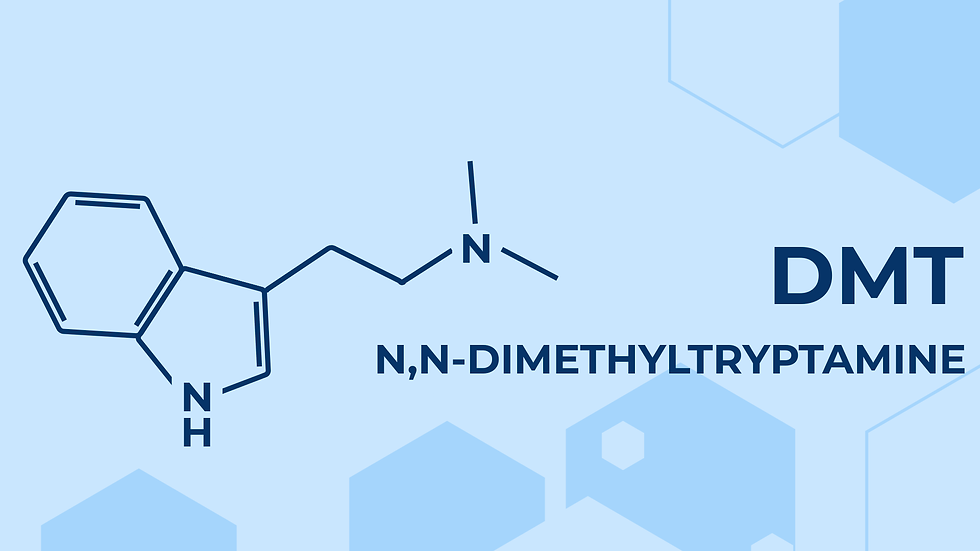
What is the science of DMT?
DMT stands for N, N-Dimethyltryptamine. It is a powerful psychedelic drug, with serotonergic effects on the human brain, which can induce a rapid and intense psychedelic experience, often referred to as a ‘DMT trip’. The DMT experience is usually characterised by visual hallucinations, frequently involving powerful entities, and is often associated with deeper meaning. This meaningful experience is sometimes called a ‘DMT breakthrough’. When used as a recreational drug, DMT can be smoked, snorted, or injected in its crystal form.
DMT is a psychedelic tryptamine and an indole alkaloid, structurally close to the neurotransmitter serotonin, differing chemically by just two extra methyl groups. This similarity lets it bind to and stimulate serotonin receptors in the brain, primarily the 5-HT2A subtype, which is thought to drive most of its hallucinogenic effects and is shared with other classic serotonergic psychedelics like psilocybin and LSD.
DMT's receptor activity is actually broader than most other classic psychedelics, though. Alongside 5-HT2A, it binds meaningfully to sigma-1 receptors, acting as an agonist there too. Sigma-1 is a protein inside cells, involved in stress responses, calcium signalling and neuroprotection, and animal research suggests this sigma-1 activity may help protect neurons under low-oxygen conditions and influence immune responses, largely independent of the psychedelic effects themselves. This is part of why DMT has attracted interest for potential non-psychedelic medical applications, something not really explored with psilocin or LSD. DMT also interacts, to a lesser and still poorly understood degree, with a trace amine receptor (TAAR1), the serotonin transporter, and a transporter involved in how neurons package and release DMT's chemical relatives.
Taken intravenously, effects begin within 30 to 60 seconds, peak at around two to five minutes, and resolve within roughly 15 to 30 minutes. Smoked or vaporised DMT follows a very similar timeline, onset within seconds and total duration of around 10 to 20 minutes, while injection into muscle (the method used in the earliest human studies of the drug) comes on slightly more slowly, around two to five minutes, and lasts a bit longer, roughly 30 to 45 minutes. This speed comes down to how quickly the body breaks DMT down, mainly through an enzyme called MAO-A, which is also exactly why DMT taken by mouth on its own has no effect. It's destroyed before it can reach the brain, unless it's paired with something that blocks that enzyme, which forms the basis of how ayahuasca works.
What are the risks?
DMT is a powerful psychedelic drug and, as with any drug, it’s important that there is an appreciation for both the psychological and physiological risks associated with its use.
DMT induces a particularly potent psychedelic experience consisting of intense visual alterations and hallucinations, alongside alterations in emotion and mood. The intensity of the trip can be emotionally challenging for some people, inducing states of panic, anxiety and paranoia. For some people DMT produces an out-of-body experience or depersonalisation, which can be an overwhelming experience. Similar to all psychedelics, the psychological risks can be minimised by ‘set and setting’, ensuring that both your mind-set is stable and well prepared, and that the environment is safe and encouraging. A sober sitter is an important safety measure to mitigate psychological harm.
Similar to other psychedelics, history of mental health illness (such as schizophrenia, psychosis and bipolar disorder) may increase the likelihood of an unpleasant experience and there is the risk DMT may exacerbate these conditions. However, there is still a limited understanding of the risks associated with the use of psychedelics in those with pre-existing mental health conditions.
It’s important to understand that DMT affects the serotonin system and therefore should not be taken in consumption with other drugs that also alter the serotonin system. This can result in a potentially life-threatening condition called serotonin syndrome. This includes some antidepressants and selective serotonin reuptake inhibitors (SSRIs).
Prescription drugs with an associated risk:
SSRIs
Antipsychotics (although many will also block the actions of DMT)
Opioids, especially
Antihypertensives
Central nervous system depressants
Vasodilators

How might the drug make you feel?
Psychological effects
DMT is rapidly acting and effects are typically observed around 2-5 minutes after consumption and last around 15-20 minutes. Despite its short-lived effects, DMT is known as one of the most powerful psychedelic drugs. The subjective effects of DMT can often be meaningful but will vary with dosage. These include:
Eliciting intense visual alterations and hallucinations, specifically colourful and geometric forms
Profound spiritual or mystical experiences
Varying alternations in mood and emotion, including experiences of euphoria, calm, fear and anxiety
Perceived encounters with external entities, which are often described as elf-like.
Altered sense of time and place
A sense of depersonalisation or out of body experiences
Potential auditory hallucinations
Evocation of powerful memorie
Physiological effects
DMT is associated with low toxicity and is easily metabolised by the body. However, there are physiological implications and associated risks to be aware of. These include elevated blood pressure and increased heart rate, which is particularly risky for those with heart conditions. The impaired cognitive and motor function poses a personal safety risk and presents further reason for DMT to be consumed in a safe environment with a sober sitter. It should be noted that at high doses there are some reports of seizures, respiratory effects and comas.
Is DMT addictive, and what are the long-term effects?
DMT, like other classic psychedelics, is not addictive. No established pattern of physical dependence or withdrawal has been documented, and animal research points to a low potential for compulsive, reinforcing use, consistent with the lack of any clear addictive pattern seen clinically. Tolerance does build quickly with frequent use, though, meaning a higher dose is needed to achieve the same effect if used repeatedly in a short space of time, a pattern shared with other serotonergic psychedelics.
Harm Reduction and Drug-Drug Interactions
DMT is a powerful psychedelic drug that can produce a rapid and intense hallucinogenic experience. Informed harm reduction advice can help to mitigate some of the associated risks.
Being educated and prepared
It is important that you fully educate yourself on the health risks and drug interactions associated with DMT. It is important to ensure that the correct form and method of consumption is used, as well as a suitable dose. The particularly intense nature of DMT makes it important that sufficient preparation is done. This includes an awareness of the psychological and physical effects that DMT may induce. Preparation is also linked to the person’s mind-set.
Set and setting
‘Set’ refers to a person’s mind-set including their mood, thoughts and expectations. This can have a significant effect on the experience of the trip and therefore it is advised that DMT is only consumed when a person is in a positive and stable state of mind. ‘Setting’ refers to the environment and social situation in which the drug is consumed. DMT should be consumed in a safe and calm environment, due to the intensity of the trip and the potential motor impairments.
Sitter
The presence of a sober sitter is particularly recommended with DMT. The sitter can provide reassurance and support during and after the trip. The sobriety of the sitter is essential and can provide a sense of clarity and guidance through any disorientating or overwhelming experiences.
Drug-drug interactions
DMT should not be mixed with alcohol or other drugs. Specific combinations to avoid include tramadol, due to an increased seizure risk, other stimulants such as cocaine and amphetamines, cannabis, and other hallucinogens, since combining psychedelics raises the risk of an unexpectedly intense trip.
MAOIs deserve their own specific warning. Combining DMT with an MAO inhibitor, whether through ayahuasca, deliberately combining DMT with a separate MAOI substance, or unknowingly through another drug fundamentally changes DMT's profile. MAO inhibition is what makes oral DMT active in the first place, and it also intensifies and prolongs the experience compared with smoked or injected DMT alone, creating a longer and more demanding risk window that requires much more caution than a typical short DMT session.

Medical Uses
DMT, when consumed as ayahuasca, has a long history of traditional medicinal use among indigenous tribes across the Amazon, and the therapeutic potential of ayahuasca as a tool in psychotherapy has generated real clinical interest, with several trials reporting beneficial effects in treating addiction and depression.
Growing mainstream interest in ayahuasca and other classic psychedelics has extended to the isolated DMT molecule itself. Scientific studies have found real similarities between DMT and psilocybin, showing that DMT can produce a comparably meaningful, mystical-type experience, and that it produces measurable changes in brain activity of the kind thought to underlie psilocybin's therapeutic effects. This has led to real interest in whether DMT could offer similar therapeutic potential to psilocybin in treating conditions like depression and anxiety.
The foundations of modern DMT research were laid by Rick Strassman at the University of New Mexico in the early 1990s, in the first FDA-approved human psychedelic studies in decades. Around 60 volunteers received intravenous DMT across a range of doses, and while not designed as therapy trials, this work mapped out DMT's dose-dependent effects on mood, heart rate, blood pressure and stress hormones, and helped pave the way for the modern wave of psilocybin and MDMA research that followed. More recently, researchers at Imperial College London have used brain imaging to study how DMT affects brain network activity and subjective experience in healthy volunteers, adding to the mechanistic picture without yet testing therapeutic efficacy directly.
The most clinically advanced programme to date used a single intravenous dose of synthetic DMT alongside psychotherapy in people with major depressive disorder. Full results published in a major medical journal in 2026 showed a significantly larger reduction in depression scores than placebo, with benefits persisting at three months and, for some participants, out to six months, and no serious treatment-related side effects. Because DMT's core psychedelic effects last only around 20 to 30 minutes, far shorter than psilocybin's multi-hour session, researchers are also exploring extended, carefully controlled DMT infusions designed to sustain the psychedelic state for longer, aiming to give more room for structured therapeutic work during the experience itself. This approach is still at an early, exploratory safety stage.
None of this amounts to an approved medicine. No DMT-based treatment has been approved anywhere in the world, and DMT-assisted therapy remains several years behind the clinical pace of psilocybin and MDMA, with depression being the clearest area of promise so far and other potential uses, including anxiety, PTSD and substance use disorders, still largely untested in controlled trials.

Myths and Misconceptions
The human brain produces DMT
There has been extensive debate over whether DMT is produced naturally in the human brain, much of it centred on the pineal gland, a small structure in the brain that has been popularly claimed to be its primary source. Scientific evidence for this specific claim remains very limited. Trace amounts of DMT have been detected in human blood and urine, supporting the idea that the body does produce some DMT naturally, and this observation fed into a research idea in the 1960s and 70s suggesting that abnormal levels of endogenous DMT might contribute to conditions like schizophrenia. That theory was never confirmed. DMT has been found in the pineal gland of rats, but not so far in the human pineal gland, and a follow-up study found DMT was still produced in rat brains even after the pineal gland was removed, casting further doubt on the idea that this one small gland is DMT's primary source. Understanding endogenous DMT production and what role, if any, it plays in normal human physiology remains an open, understudied question.
DMT and 5-MeO-DMT are similar
5-MeO-DMT stands for 5-Methoxy-N,N-Dimethyltryptamine. While they may look similar, and have similar chemical structures, they induce different experiences and should not be confused.
History and Where the Research Stands
DMT was first synthesised in 1931 by Canadian chemist Richard Manske, though its psychoactive properties were not recognised at the time. That recognition came in 1956, when Hungarian chemist and psychiatrist Stephen Szára, unable to source LSD, self-administered synthetic DMT by injection and documented intense visual hallucinations and altered consciousness lasting around 30 to 45 minutes, the first formal record of DMT's psychoactive effects in humans. DMT was later found to occur naturally in numerous plants, including Psychotria viridis (chacruna) and Mimosa hostilis (jurema), linking it directly to the long-standing Amazonian ayahuasca tradition, in which a DMT-containing plant is combined with an MAOI-containing vine, typically Banisteriopsis caapi, a pairing developed through centuries of indigenous botanical knowledge. It has since been identified in many further plant species and in trace amounts in some animal tissues.
Formal clinical research resumed in earnest with Rick Strassman's studies at the University of New Mexico between 1990 and 1995, the first FDA-approved psychedelic research in decades, later popularised in his book DMT: The Spirit Molecule, which helped re-establish psychedelic science within mainstream regulatory frameworks and influenced the modern wave of psilocybin and MDMA trials. More recent commercial and academic momentum includes the consolidation of a leading DMT clinical programme following a major 2023 acquisition, and ongoing academic work into extended-state DMT infusions designed to sustain the psychedelic state for longer than a typical short session.
Despite this research progress, DMT remains one of the most tightly restricted drugs in the world. In the UK it is a Class A drug under the Misuse of Drugs Act. In the United States it is Schedule I under the Controlled Substances Act, reflecting an official position of high abuse potential and no accepted medical use. Similar strict controls exist across the EU, and throughout most of Asia and Latin America, generally implementing the UN Convention on Psychotropic Substances. A narrow exception exists for ayahuasca in specific religious contexts: a landmark US Supreme Court ruling in 2006 protected the sacramental use of ayahuasca by the União do Vegetal church, and related exemptions have since been granted to Santo Daime churches in the US and elsewhere. These exemptions are tightly limited to defined religious practice and do not extend to isolated DMT, non-religious ayahuasca use, or recreational use of any kind.
