

From Clinics to Culture: Exeter’s Psychedelic Interdisciplinary Centre (EPIC) Signals a New Phase for UK Psychedelic Research

Author
Ryan Khan
The UK’s psychedelic research ecosystem is evolving quickly. Over the past decade, institutions such as the Imperial College London Centre for Psychedelic Research, King’s College London Psychoactive Trials Group, University College London Centre for Consciousness Research, and more recently the University of Cambridge Psychedelic Research Group have helped establish psychedelic science within mainstream academic and clinical settings. Much of this work has focused on neuroimaging, neurobiology, psychiatric applications, and clinical translation, contributing to a broader shift in how psychedelics are perceived across medicine and mental healthcare.
However, the newly launched Exeter Psychedelic Interdisciplinary Centre (EPIC) appears to be asking a broader question altogether: what if psychedelics are not only medical tools, but cultural, philosophical, ecological, and social phenomena that require fundamentally interdisciplinary approaches?
Hosted at the University of Exeter, EPIC describes itself as “a world leading academic hub for psychedelic research, education and community,” with ambitions that extend beyond individual treatment outcomes toward “societal healing, cultural renewal, ecological awareness, and new forms of collective flourishing.”
That framing remains unusual within institutional psychedelic science, where research has historically focused on clinical efficacy, mechanisms of action, and transdiagnostic applications.

Beyond the biomedical
Modern psychedelic research has largely been driven by psychiatry, neuroscience, and drug development. The field’s post-2000 revival relied heavily on demonstrating clinical efficacy and biological plausibility in tightly controlled research settings. Institutions seeking legitimacy understandably prioritised randomised controlled trials, neuroimaging studies, and translational psychiatric models. EPIC does not reject that framework, although it appears deliberately unwilling to be confined by it.
Across its public-facing platforms, the centre repeatedly positions itself at the intersection of faculties, cultures, and epistemologies: “between academic disciplines; self and other; community and individuality; Western medicine and Indigenous healing; the human and more-than-human.”
Its research agenda reflects this orientation. Alongside neuroscience and clinical applications, the EPICentre foregrounds metaphysics, anthropology, ecology, ritual, ethics, phenomenology, group processes, and political change.
The EPIC team formally celebrated its in-person launch on 6th May, followed by an inaugural online event in collaboration with The Psychedelic Society on 11th May 2026.
As Programme Director, Dr. Andy Letcher puts it:
“The EPIC team is made up of a brilliant and erudite group of researchers, and to have a major university researching psychedelics — I never thought that could happen.”
In practice, this means the centre is engaging questions that many psychedelic researchers have historically treated as peripheral or difficult to operationalise:
How do communal and ceremonial contexts shape psychedelic experiences?
Can psychedelics function as “social cures” rather than purely individual treatments?
How should academic institutions ethically engage Indigenous knowledge systems?
Might psychedelics influence ecological consciousness or political behaviour?
What philosophical implications emerge from psychedelic alterations of consciousness?
Some EPIC-affiliated research engages these questions directly. The Mind At Large Project, led by philosopher Dr. Peter Sjöstedt-Hughes, explores whether altered states challenge conventional assumptions about consciousness and the relationship between mind and brain. While such questions remain controversial within mainstream neuroscience, they reflect EPIC’s willingness to engage lines of inquiry many psychedelic researchers consider philosophically unavoidable.
As Sjöstedt-Hughes argues:
“Instead of seeing psychedelics as poisons, we see them as medicines in the West. What does that mean? How do they work as medicines? What opportunities haven’t we even thought about yet? What’s the potential not just for psychedelics as medicines, but as creative instruments, nootropics, or catalysts for metaphysical insight?”

An interdisciplinary team with broad ambitions
EPIC’s faculty composition itself reveals much about the centre’s ambitions. The team includes psychopharmacologists, philosophers, psychiatrists, anthropologists, religious scholars, neuroscientists, and consciousness researchers.
Professor Celia Morgan, one of the UK’s most established psychopharmacologists, brings extensive experience in ketamine and psychedelic-assisted therapy research. Her work has contributed significantly to psychedelic healthcare development and clinical trial infrastructure in the UK, and she serves on the Scientific Committee of Drug Science, the UK charity focused on advancing evidence-based drug policy and education.
Morgan is currently leading the multi-site MORE-KARE study, assessing ketamine-assisted psychotherapy for severe alcohol use disorder across eight NHS sites. The trial represents one of the UK’s most advanced investigations into ketamine-assisted psychotherapy within public healthcare infrastructure.
Morgan says:
“I’ve been working with psychedelics for more than 25 years, and what genuinely excites me about EPIC is how open and interdisciplinary the framing is. It creates space to ask more unconventional questions within clinical research itself.” She adds, “ as the trial is state-funded, it isn’t shaped by the same commercial pressures driving many other late-stage psychedelic studies.” Uniquely, “That gives space to explore more innovative dimensions of the work, including some of the ceremonial and contextual aspects surrounding ketamine use.”
Meanwhile, Senior Lecturer Dr. Leor Roseman, formerly of Imperial College London’s Centre for Psychedelic Research, brings expertise spanning neuroscience, phenomenology, anthropology, and conflict resolution. Roseman is also co-founder of Ripples Alliance, a nonprofit exploring psychedelics in peacebuilding and collective healing contexts between Palestinians and Israelis. Roseman says:
“The idea behind EPIC was almost like assembling a team in Ocean’s Eleven. You need an anthropologist, a religious scholar, a philosopher, a neuroscientist – people with established expertise coming together to build something collaborative.”
The wider faculty further reinforces the centre’s interdisciplinary orientation, spanning psychiatry, Indigenous science, philosophy of mind, ecology, religion, neuroscience, and psychotherapy research. Neuroscientist and psychotherapist Dr. Anjali Bhat explained that the team was small:
“but each of us approaches the same subject from a completely different angle — and psychedelics are exactly the kind of subject that calls for that.”
Researching psychedelics beyond the clinic
One of EPIC’s more distinctive contributions may be its explicit focus on psychedelic use outside conventional medical environments.
The centre’s “Communities of Practice” research theme examines retreats, rituals, ceremonies, and collective psychedelic contexts, while also exploring “psychedelics as a potential social cure.”
This marks a significant departure from the dominant model of psychedelic science, which has largely centred laboratory and clinic-based administration. While such clinical models remain essential for regulatory approval and medical legitimacy, they arguably represent only a small fraction of global psychedelic use.
Its PsiCommunity of Practice (PsiCoP) project, for example, explores group psilocybin administration outside clinical settings using community-oriented frameworks inspired by Gathering Groups and Roots to Thrive models. Led by Dr. Leor Roseman, Professor Celia Morgan, and PhD researcher Max Crosland-Wood, the study investigates how collective preparation, shared integration, and peer support may shape psychedelic outcomes beyond highly medicalised therapeutic environments.
By focusing on group administration models, the project also challenges the heavily individualised therapeutic frameworks that have largely dominated psychedelic medicine thus far.
“The PsyCommunity of Practice study is the first randomised controlled trial comparing individual versus group-based psychedelic healing models,”
says Crosland-Wood.
“The study explores whether collective meaning-making, peer support, and group integration processes can improve long-term outcomes beyond highly individualised therapeutic frameworks. We’re ultimately interested in whether community-based psychedelic care models could operate at public health scale and potentially reduce pressure on overstretched mental health systems.”
This emphasis on real-world psychedelic contexts is also reflected in EPIC-affiliated observational studies examining ayahuasca use among military veterans attending legal ceremonial retreats. Led by psychiatrist Dr. Simon Ruffell, and completed in collaboration with Onaya Science, the project combines psychometrics, EEG, microbiome analysis, metabolomics, and epigenetic assessment to investigate long-term psychological changes associated with ceremonial ayahuasca use.
A related observational project explores whether ceremonial ayahuasca practices may hold relevance for trauma and traumatic brain injury recovery among former elite-level athletes.
Ruffell argues that EPIC creates space for kinds of inquiry often difficult to pursue within conventional scientific structures. Ruffell says:
“I’ve always felt frustrated by how reductionist much of Western scientific research can become. EPIC is one of the few places where different disciplines can genuinely come together in a way that allows expansion beyond the normal confines of Western science.”
That emphasis comes amid growing debate across the psychedelic field regarding cultural appropriation, reciprocity, traditional knowledge systems, and the ethics of translating Indigenous practices into Western therapeutic and commercial frameworks.
Ruffell adds:
“The project I’m most excited about at the moment involves using psilocybin in group settings to explore insight and creative problem-solving around climate change. It’s bringing together psychedelics, ecology, shamanic practices, and Indigenous knowledge systems in ways that haven’t really been explored before.”
Morgan and Ruffell also serve on Drug Science’s Medical Psychedelics Working Group, contributing to the charity’s efforts to advance evidence-based policy, education, and clinical guidance surrounding psychedelic therapies.
Mechanisms, therapy, and translational research
Despite its broad philosophical and cultural framing, EPIC is also engaged in more traditional scientific and clinical psychedelic research.
The centre’s “Mechanisms of Action” and “Therapeutic Applications” themes explore how psychedelics influence cognition, emotion, neurobiology, and psychological flexibility, while also investigating their therapeutic potential across a range of mental health conditions.
One example is the Beckley LSD Study, a high-resolution neuroimaging project using 7-Tesla MRI and MEG technology to investigate the neural correlates of LSD-induced altered states and mystical-type experiences. Led by Bhat and funded by The Beckley Foundation, the study aims to empirically test the REBUS theory of psychedelics using ultra-high-resolution brain imaging.
“We want to understand the psychedelic experience in much finer detail, while simultaneously examining what’s happening in the brain under high doses of LSD,” Bhat explains. “Our aim is to map the neural correlates of subjective experience across eight to ten hours in unprecedented detail.”
Alongside neuroimaging, the project also incorporates stem-cell and brain organoid modelling to examine psychedelic effects across multiple levels of biological analysis.
EPIC researchers are also investigating ketamine’s therapeutic and addictive mechanisms through the KOSMOS project, led by Morgan alongside Joy Krecké and Sam Hughes. The study combines pharmacological manipulation, EEG, behavioural testing, and psychological analysis to explore how ketamine’s therapeutic and rewarding properties may emerge through overlapping or distinct neurobiological mechanisms.
This balance between biomedical research and broader psychosocial inquiry may ultimately become one of EPIC’s defining features. Rather than positioning clinical science and cultural inquiry as opposing frameworks, the centre appears to view them as mutually informative.
Education as infrastructure
EPIC is not only building a research centre, it is helping institutionalise psychedelic studies as an academic discipline.
The University of Exeter now offers in-person and online MSc programmes in Psychedelics: Mind, Medicine and Culture, alongside postgraduate certificates and a growing cohort of PhD researchers. The programme reflects EPIC’s transdisciplinary ethos, spanning neuroscience, psychotherapy, anthropology, ethics, metaphysics, history, and cultural studies.
The programme’s structure itself reflects EPIC’s transdisciplinary ethos. Modules span neuroscience, psychotherapy, anthropology, ethics, metaphysics, history, and cultural studies, with students encouraged to move fluidly between scientific and philosophical perspectives.
“What makes this MSc unique is the diversity of people it brings together — not just clinicians, but students from a wide range of backgrounds and experiences,” says Cathy Agnihotri, a student on the MSc Psychedelics: Mind, Medicine and Culture programme. “Studying anthropology, neuroscience, neuropharmacology, and metaphysics side by side has created a genuinely transdisciplinary way of thinking that’s been deeply transformative.”
Beyond the curriculum itself, students also describe the centre as unusually collaborative and non-hierarchical compared to more conventional academic environments.
“What’s striking about EPIC is how open and collaborative the culture feels,” says Crosland-Wood. “There’s a much flatter relationship between students and faculty than in many academic environments, and real freedom to explore unconventional research questions that might face more resistance elsewhere.”
Morgan says the centre emerged through a shared recognition that psychedelic research required deliberately cross-disciplinary collaboration. “What unites everyone here,” she says, “is a wild curiosity and enthusiasm for the field.”
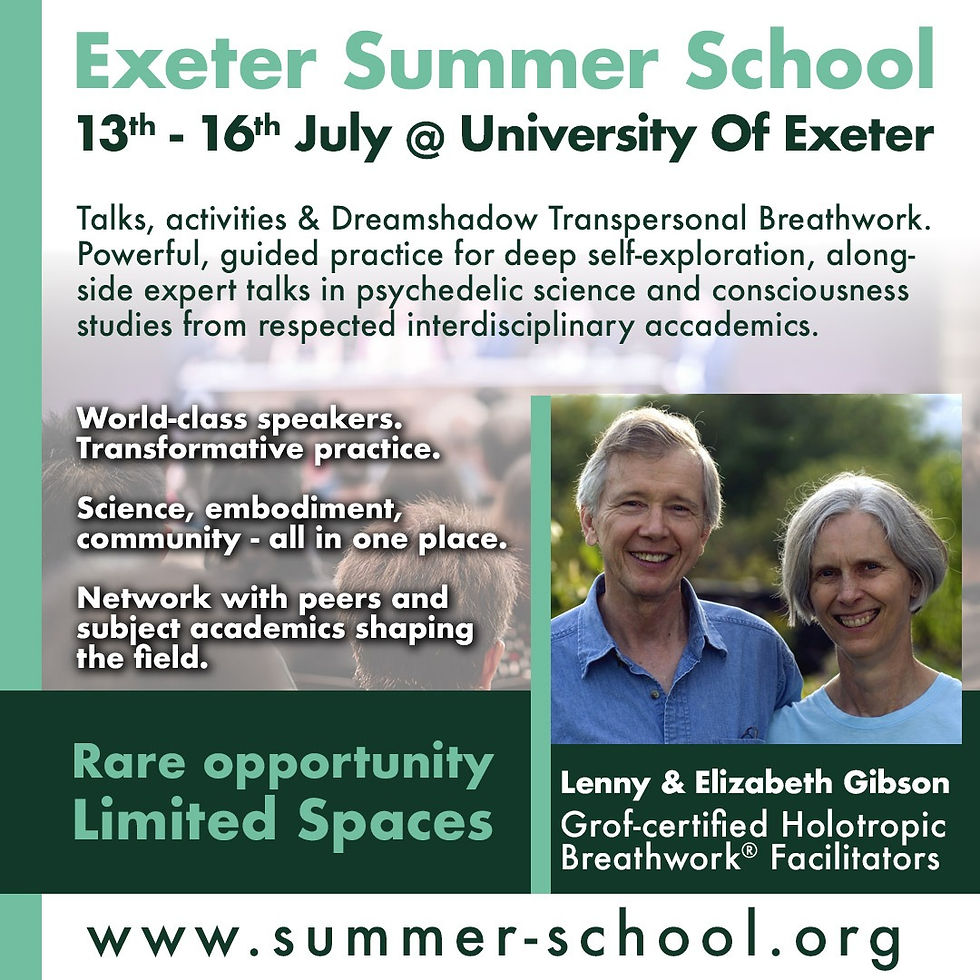
EPIC’s ambitions also extend beyond formal academia. Its upcoming 2026 Summer School, open to the public, combines psychedelic science, clinical education, breathwork, and experiential workshops into a multi-day programme featuring researchers, therapists, and Grof-certified facilitators.
Ruffell says one of the centre’s strengths is its culture of openness and dialogue.
“It doesn’t matter whether you’re a student or a member of staff, the conversations are real, organic, and respectful. I’ve loved seeing students evolve and forge their own ways forward.”
A Psychedelic "Ecosystem"
EPIC repeatedly uses the word “ecosystem” to describe its role, a notable difference in framing compared to many academic institutions.
The centre appears designed less as a conventional academic department and more as a convening platform connecting researchers, clinicians, philosophers, artists, activists, and community organisations.
Its Exeter Transdisciplinary Psychedelic Colloquium reflects this approach. Bi-weekly hybrid gatherings feature speakers ranging from neuroscientists and filmmakers to Indigenous researchers and harm reduction advocates, including figures such as David Nutt, Adana Omágua Kambeba, Bruce Parry, and Henry Fisher.
The centre is also connected with organisations including MAPS, Compass Pathways, Drug Science, Breaking Convention, Libero Pharma, The Sacred Stream, Nostromo Foundation, and the Economic and Social Research Council.
Several EPIC faculty members have also contributed to wider public discourse around psychedelics through appearances on the Drug Science Podcast, including Celia Morgan, Simon Ruffell, Peter Sjöstedt-Hughes, and Andy Letcher.
For critics, such blending of academia and psychedelic culture may risk diluting scientific rigour or encouraging overly expansive claims about psychedelic potential. At the same time, supporters may argue that psychedelic science has long struggled with the opposite problem: reducing profoundly complex social and existential phenomena into narrowly biomedical models.
As Letcher puts it:
“Psychedelics throw up a whole panoply of questions, and we need all these different perspectives to gain anything like a reasonable picture of what psychedelics are, how they work, and most importantly, what they mean.”
The next phase of psychedelic science?
The launch of EPIC may signal something larger than the arrival of another university psychedelic centre.
The first wave of modern psychedelic science fought primarily for legitimacy. Researchers needed to demonstrate safety, therapeutic potential, and scientific credibility within highly sceptical institutional environments.
But as psychedelic research becomes increasingly established within universities, hospitals, and regulatory systems, the field’s questions are broadening.
The debate is no longer only whether psychedelics “work.” Increasingly, institutions are beginning to ask what psychedelics are for - and what broader cultural and philosophical frameworks should surround their use.
“There is so much more that psychedelics can offer us,” says Sjostedt-Hughes, “because ultimately what they allow for is the expansion of mind, self-consciousness, and our understanding of consciousness within nature itself.”
Whether EPIC succeeds in integrating such expansive ambitions into rigorous academic practice remains to be seen. But its launch suggests psychedelic research in the UK may be entering a new phase - one less concerned solely with clinical legitimacy, and more willing to engage the deeper social and existential questions psychedelics continue to provoke.